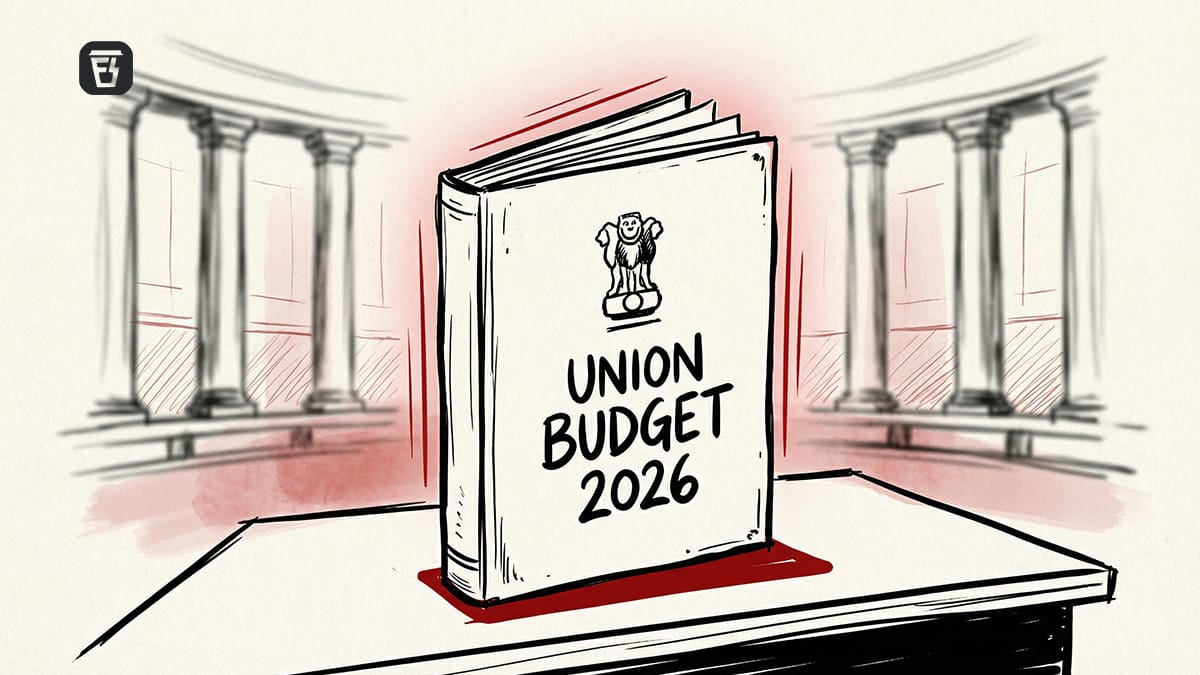
India’s Union Budget for 2026-27 lands at a pretty wild moment. The world’s still dealing with supply chain headaches, global power struggles, and tech moving faster than anyone can keep up. In this chaos, the budget sets out a big, confident plan. It puts “Viksit Bharat 2047” front and centre, betting big on public capital spending, sweeping reforms, and targeted industrial moves. It all sounds bold, but there’s a louder debate than ever over who really benefits and whether jobs will actually follow.
A Big Bet on Infrastructure
The government is raising public capital spending to ₹12.2 lakh crore for 2026–27. It’s a lot of zeroes and a clear sign they’re sticking with an investment-led growth strategy. High-speed trains, more freight corridors, and new national waterways: it’s full steam ahead on logistics and connecting the country in new and faster ways. There’s even an Infrastructure Risk Guarantee Fund in the works, meant to attract private money by taking some of the bite out of project risks.
The basic idea? Spend big, create jobs, boost demand, and build a stronger backbone for long-term growth. Still, critics keep pointing out the obvious: construction jobs are great now, but what happens later? There’s real doubt about whether this approach will lead to lasting work, especially for young people and those in the informal sector.
MSME Push: Ambition Meets Old Problems
Small and medium businesses (SMMEs) are still at the heart of the story. There’s a ₹10,000 crore SME Growth Fund, new rules to make sure payments don’t get stuck, and “Corporate Mitras” to help with compliance headaches.
The government is also trying to boost biopharma and textiles, chasing exports and cutting back on imports. But big challenges stick around: informality, low tech, and not enough links to the global value chain. Without broader changes to labour laws, training, and digital tools, these new initiatives might not go very far.
Green Push: Steps in the Right Direction, but is it enough?
Exempting customs duties on lithium-ion battery parts and key minerals shows India wants a piece of the green economy. Clean energy and supply chain strength aren’t just about the planet anymore; they’re increasingly seen as economic lifelines.
Still, some critics say incentives alone won’t cut it. Without serious spending on climate adaptation, especially for people hit hardest by extreme weather, the picture remains incomplete.
City Economic Regions: Rethinking Urban India
The plan to build City Economic Regions, each receiving ₹5,000 crore over five years, could significantly reshape how cities grow. By focusing on what each city does best, the government hopes to close regional gaps and make cities more productive.
But money alone isn’t enough. Pulling this off means states need to build stronger, better governance and real teamwork across different levels of government.
Fiscal Tightrope and Persistent Worries
Aiming for a 4.3% fiscal deficit signals the government wants to keep things stable, even as it spends big on infrastructure. They’re planning to borrow ₹11.7 lakh crore from the market too, so keeping investors on board is crucial.
But the worries aren’t going away:
• Private consumption still hasn’t bounced back
• Jobs are growing, but unevenly
• Inequality’s getting worse
• The global economy is as unpredictable as ever
Some economists call all this “infrastructure-heavy but demand-light.” They argue that a little more direct income support or stronger measures to boost household spending right now could have helped kick-start short-term growth.
Conclusion
This budget isn’t shy. It’s all-in on infrastructure, MSMEs, simpler taxes, a greener push, and fiscal discipline. It sends a strong message: India is betting on investment to drive its future.
But here’s the real test: Will all this spending actually deliver good, lasting jobs? Will the reforms make growth more inclusive? Can fiscal discipline hold up if the world economy turns rough again?
Budget 2026–27 is definitely bold. Whether it’s truly transformative will ultimately come down to how well the plans are carried out, how strong the institutions are, and whether all this capital spending really turns into something more than numbers on a page.
Written by – Maria Mabood
Edited by – Devangee Kedia