
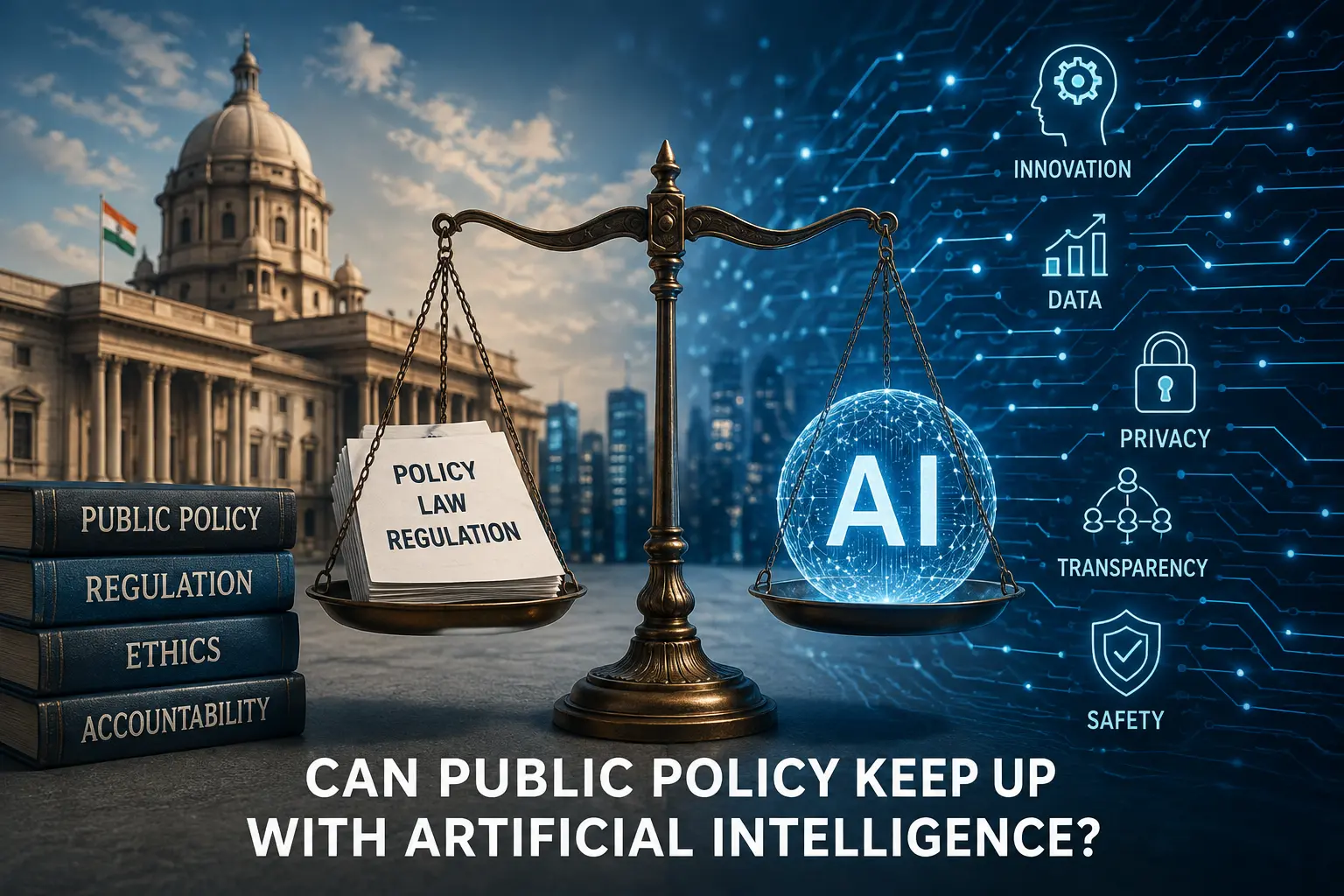
AI and the Changing Policy Landscape
A review of the ability of the government to keep up with the fast pace of technological change. AI is now an integral part of our daily lives. Whether it is through tools such as ChatGPT for virtual assistance or recommendation algorithms on Netflix for binge-watching or fraud detection in the banking sector, AI is changing our lives in many ways as we work, learn, communicate and make decisions. As AI is growing, it is facing challenges in effectively regulating.
The Challenge of Regulating Artificial Intelligence
Against this background, can public policy keep up with artificial intelligence? The rate of technology change is the most complicated. While policy is a slow and long process, AI models are taking a few months to improve. The process and necessary checks and balances for a bill to become law include consultations, expert review, parliamentary debate and legal scrutiny. When regulations are implemented, by the time regulations come into effect, the technology they are intended to govern may have evolved considerably. Consequently, governments are often responding and not predicting AI developments.
Read More: Rethinking Cybersecurity for AI-Driven Threats
The European Union AI Act and AI Accountability

This is an issue that has been well demonstrated in the recent events that have taken place worldwide. The European Union AI Act is the first comprehensive regulatory framework for AI in the world and has begun to be enforced in practice. The European Union AI Act is the world’s first comprehensive legal framework for the regulation of Artificial Intelligence, and it is now being implemented. Depending on the particular AI model, it may be hard to explain why it makes certain decisions, as many models are considered “black boxes”. This, in turn, raises the important question of where responsibility lies when your AI system causes harm the AI developer, the company using the AI, or the end user? There needs to be accountability in place for policymakers to ensure AI is transparent, explainable, and fair.
AI, Privacy and Personal Data
Another area where policy needs to evolve rapidly is privacy. AI systems need a tremendous amount of data to be effective. All online searches, digital payments, location, photos, and social media activity add to the data that is used to train AI models. This data is then used to enhance the performance of AI, but it also poses threats of surveillance, unauthorized data collection, and misuse of personal information. They have the right to transparency and security over how their data is gathered, recorded, shared and safeguarded. Effective enforcement and robust privacy regulations are important for the good governance of AI.
The Risks of Overreliance on AI
Over a period of time, there have been instances that demonstrate the danger of overreliance on AI without sufficient supervision. In India, worries have been raised regarding the utilization of AI-created lawful substance, with false case references in legitimate India, there have been concerns raised regarding the use of AI-generated legal content due to the emergence of fabricated case citations in legal proceedings. This shows that not all information created by AI is necessarily true without the involvement of humans. Also, they highlight the importance of ethical principles and professional guidelines for the application of AI in areas of a sensitive nature like legal, health, journalism and education.
Balancing AI Innovation and Regulation
At the same time, governments need to pay attention to not stifling innovation by over-regulating AI. The possibilities of AI’s impact on services, scientific research, disaster management, agriculture, and healthcare are vast and promising, offering opportunities to create more efficient, effective, and affordable public resources or goods. AI’s potential in public services, scientific research, disaster management, agriculture, and healthcare is immense and holds great promise for more efficient, effective, and scalable public goods. Too much regulation may create a drag on investment and limit the possibilities for start-ups and research, especially for developing economies. Policymaking should thus focus on providing a framework conducive to innovation, but which minimizes the risks to society.
The Future of AI Public Policy

My view is that the big question is not whether governments are able to control Artificial Intelligence; it is whether they can transform it fast enough to be able to govern it responsibly. Traditional policymaking was developed for the case of technologies that evolved slowly. AI continues to evolve, and policies need to be adaptable, regularly reviewed and mutually developed and agreed upon by governments, researchers, technology companies, and civil society. Regulation should be regarded as a continuous task that will develop as technology advances, not just as a legislative act.
Conclusion: Can Governments Keep Up With AI?
AI is going to impact the future of human beings. Not only technological advances but also policies that steer them will determine if that future is prosperous or challenging. Governments need to strike a delicate balance between innovation and the public interest. With a balance achieved by policymakers, AI can prove to be one of the most impactful technologies for economic growth, social development and human well-being. If it isn’t achieved, then society could be perpetually playing catch-up with an ever-changing technology.
Written by- Vidhi Mehta