
“With Prodigious Potential comes Prodigious Risk”
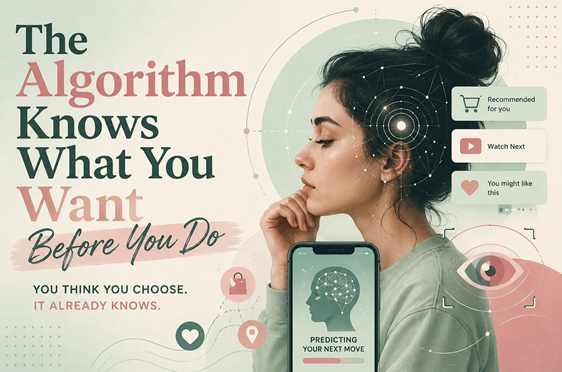
You mention a pair of running shoes to a friend over coffee. By evening, they are following you around the internet. Whether or not your phone was “listening”, the unsettling truth is that it usually didn’t need to. The algorithm doesn’t read your mind. It reads your patterns, and it is startlingly good at it.
PREDICTION AT SCALE.
Most personalisation runs on a simple logic. The system notes what you have watched, clicked or bought, compares it with what millions of similar people have watched, clicked or bought, and infers that you must be interested in whatever they liked next. Every click is a small confession. Over time those confessions add up to something more valuable than a list of preferences: a working model of who you are, what moves you, and when you are most likely to say yes.
On its own, that is not sinister. Recommendations save time, and a good one can surface a book or a song you would have missed. The real question is what the model is being built for.

FROM THE CHECKOUT AISLE TO BILLIONS.
Walk through any supermarket and you will find candy and chocolate at the checkout, placed at a child’s eye level. Nobody is forcing anything. The design simply makes a child whine and a tired parent give in. This is persuasion architecture: shaping an environment so that the choice you were nudged toward feels like the one you made.
In a physical store, that architecture is the same for everyone. Online, it doesn’t have to be. Digital persuasion can be built at the scale of billions and tailored to each person. It can infer your insecurities, your habits, even the time of night you are most impulsive, work out your weak spots, and then deliver exactly the nudge most likely to work on you.
A countdown timer, an “only two left” banner, a hidden fee that appears at checkout, a subscription that is easy to start and painful to cancel: these are known as dark patterns, and they are not rare. A 2022 European Commission study found that 97% of the most popular websites and apps used by EU consumers deployed at least one. A 2026 report on Indian online marketplaces found that 88% of the country’s online buyers lose money to hidden charges, subscription traps, false urgency and similar tactics.
THIS IS BIGGER THAN ADS.
It is tempting to file all of this under “annoying advertising”. That undersells it. AI is a category above online ads. Ads are one application; the underlying capability is profiling, inference and prediction applied to human behaviour, and it can be pointed at far more than shopping: what news you see, what you believe about an election, what you come to think of as normal.
Techno-sociologist Zeynep Tufekci has argued that we are building a dystopia just to get people to click on ads, because the same algorithms that sell us products also organise our access to political and social information. Digital technology is not just ads, and AI can accelerate our understanding in countless areas of life. But the same power that can advance research can also be used for mass manipulation and surveillance.
THE REAL RISK IS NOT THE MACHINE.
Here is where the fear is often misplaced. We do not need to fear what AI will do to us on its own. AI is probabilistic, not ethical: it predicts what you are likely to do, with no inherent ethics and no grasp of consequences. Recommendation engines are typically tuned for clicks and revenue, not your wellbeing. The risk is the people deciding what it is optimised for, and how they will use it to control and influence us in subtle, hidden and unexpected ways.
Much of the technology that threatens our freedom and dignity in the near future is built by companies whose business is capturing our data and attention and selling access to it, to advertisers and others. Facebook, Google and Amazon are the best known examples, and their incentives are no mystery: more attention, more data, more sales. When data-driven profiling, targeted ads and machine learning are used to influence behaviour, decisions and even democratic processes, often without the public noticing, the issue stops being consumer annoyance and becomes a question of power. Who designs the nudges? Who gets to see how they work? Who is accountable when they cross a line?
THE QUIET COST: INTELLECTUAL ATROPHY.
There is a second cost that is harder to see because it happens inside our own heads. When the algorithm keeps serving what it infers you want, you drift into a narrower world. In AI terms, personalisation mostly exploits what you already like instead of exploring something new, so you discover less. Taste that is never challenged hardens, and curiosity that is never required fades.
Call it intellectual atrophy: the slow, silent erosion of our ability to think critically and deeply. It is the very capacity we need to question a recommendation, spot a manipulative nudge and make our own decisions. If a feed picks your purchases, your preferences get shaped rather than expressed. You have outsourced the choosing, and what is left is a choice among the few options picked for you.

THE FAIR COUNTERARGUMENT.
None of this makes personalisation a villain. Recommendations can reduce decision fatigue, freeing our limited mental energy for the choices that matter most. And AI genuinely has the potential to advance research and human understanding. A system that helped you discover something new, rather than just more of the same, would be a good use of the technology. The problem is not personalisation itself but its purpose and its transparency: whether it serves the shopper or the seller, and whether we can tell the difference.
RECLAIMING OUR AGENCY.
So, what can an ordinary shopper do?
- Pause before you buy. Urgency is a tool. Waiting 24 hours defeats most countdown timers.
- Compare elsewhere. Check prices and reviews outside the platform that is pitching you.
- Seek out the unfamiliar. Search deliberately, follow something outside your usual taste, and make exploration a habit rather than an accident.
- Limit what you give away. Review privacy and ad settings, and decline tracking you don’t need.
- Ask better questions. Why am I being shown this? Who benefits if I click?
Knowing how persuasion is built is half the defence. Steve Jobs did not invent the computer; he changed how people interact with technology by combining technology, psychology and product design. Marketing manipulation works for the same reason: it fuses data science, consumer psychology and interface design. Understanding all three is how we spot it.
CONCLUSION.
The algorithm may know what you want before you do, but knowing is not the same as deciding. The technology is not the enemy; unexamined power is. So be a collaborator, not a consumer: an informed, deliberate shopper who treats a recommendation as a first draft and keeps a human, you, in the decision. We should also demand transparency and stronger rules from those who build and deploy these systems. AI should serve us, not numb us.
REFERENCES
- Zeynep Tufekci, “We’re building a dystopia just to make people click on ads” (TED)
- European Commission Digital Fairness Check research, as summarised by the Irish Times
- Datum Intelligence, Dark Patterns in India’s Online Marketplaces (Q1 2026), as reported by Business Today
- Silva et al., “Dark patterns: reclaiming autonomy in online shopping in the age of AI” (2026)
- https://medium.com/activated-thinker/the-algorithm-knows-what-you-want-before-you-do-3ad94f597170
- https://blog.richardvanhooijdonk.com/en/are-you-buying-what-you-want-or-is-ai-in-control/
- https://www.youtube.com/watch?v=6VTSAs4Rsck&t=5285s&pp=0gcJCSkMAYcqIYzv
Written by: Pranav Bongirwar
Edited by: Priyal Patel