

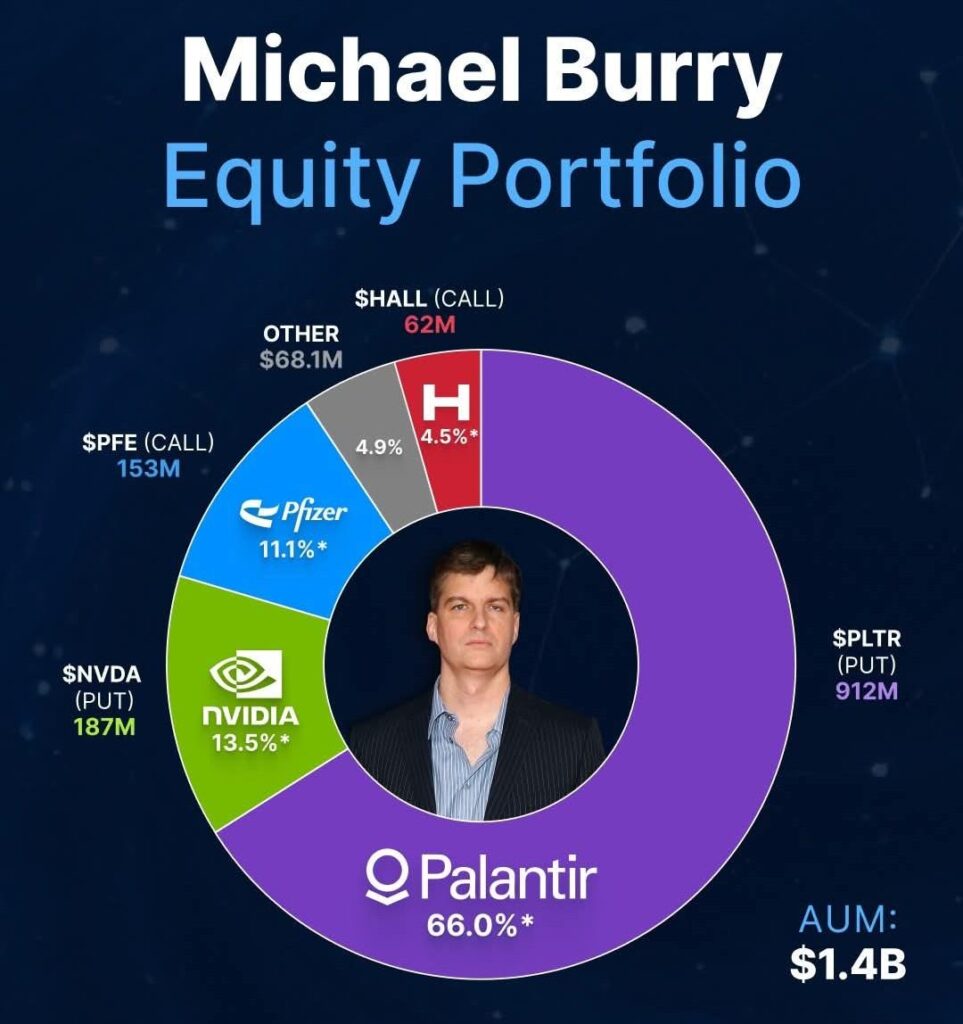
Michael Burry, the investor immortalised by “The Big Short” for predicting the 2008 financial crisis, has done it again. He is challenging the entire economic world with a high-stakes play against the very engine powering the current stock market rally: Artificial Intelligence. This high-conviction trade involves acquiring put options with a notional value of approximately $1.1 billion, primarily targeting NVIDIA and Palantir. Burry’s history of standing alone against market euphoria forces every investor to seriously consider his central question: has the AI boom become a bubble ready to burst?

The Mechanics of a Billion-Dollar Short
Burry’s entire philosophy is built on finding market exuberance and betting against it. His current strategy is structured through put options, a highly leveraged instrument that gives him the right to sell an asset at a predetermined price. The value of these contracts soars only if the underlying stock price declines significantly, making this a direct wager on a severe price correction in the AI giants. The sheer scale of the $1.1 billion exposure signals Burry’s profound conviction that the valuations of these AI leaders are entirely detached from fundamental financial reality.
NVIDIA: The $4.5 Trillion Valuation Dilemma
The core target of Burry’s scepticism is NVIDIA, which recently commanded a market capitalisation of around $4.5 trillion. The company’s recent results are spectacular: a fiscal third-quarter 2026 revenue of $57 billion, representing a stunning 62% year-over-year increase. The Data Centre segment alone, the engine of its AI dominance, delivered $51.2 billion. Burry’s argument hinges on the fact that the stock is currently priced for an extrapolation of this hypergrowth that he believes is financially improbable. The market is projecting a future without friction or competition, a scenario Burry’s research rejects.
Structural Risk: The Infrastructure Spending Peak
A fundamental pillar of Burry’s bearish outlook is the argument that the current surge in revenue is the outcome of a massive, one-time global capital expenditure cycle. Cloud providers (hyperscalers) are frantically buying NVIDIA chips to build their initial AI infrastructure. Burry posits that once this foundational buildout peaks, the astonishing growth rates will inevitably decelerate sharply. This expected “normalisation” of growth will, in his view, expose the premium valuation of the stock, causing a massive correction as investor expectations realign with slower, more realistic revenue projections.
Financial Integrity: The Depreciation Time Bomb
Burry has also introduced a critical and subtle accounting critique to the debate. He claims major cloud providers may be inflating their reported earnings by using aggressive depreciation schedules for their expensive AI hardware. By extending the estimated useful life of these assets from a conservative two to three years to an optimistic five to six years, they significantly understate annual depreciation costs. This practice artificially boosts reported profits across the AI ecosystem, creating an “earnings bubble” that is vulnerable to a sharp correction if regulators mandate more conservative standards. He suggests this understated depreciation could be worth nearly $176 billion across the sector from 2026 to 2028.
Geopolitical Constraints and Capped Potential
External, non-market factors are also integral to Burry’s short thesis. The U.S. government’s geopolitical restrictions on the export of NVIDIA’s most advanced AI chips to strategically important markets, most notably China, immediately place a non-market ceiling on the company’s total addressable market. This government action limits a crucial growth vector, reinforcing the idea that the stock is priced for a global market opportunity that is constrained by political reality.

Conclusion
Whether Burry’s $1.1 billion bet is a prescient insight that echoes his 2008 triumph or a premature short against an unstoppable technological revolution remains the central question. While his history demonstrates a peerless ability to spot systemic risk, it also shows he can be “right but early,” a timing risk that proved challenging in past positions. Nevertheless, Burry’s massive, high-profile wager has successfully compelled the global financial community to confront the fundamental risks underpinning the AI sector’s dazzling, but perhaps dangerously inflated, valuations. The final verdict on this showdown between market euphoria and rigorous financial scepticism is yet to be delivered.
Written by – Aman Madan
Edited by – Rubina Shaikh